
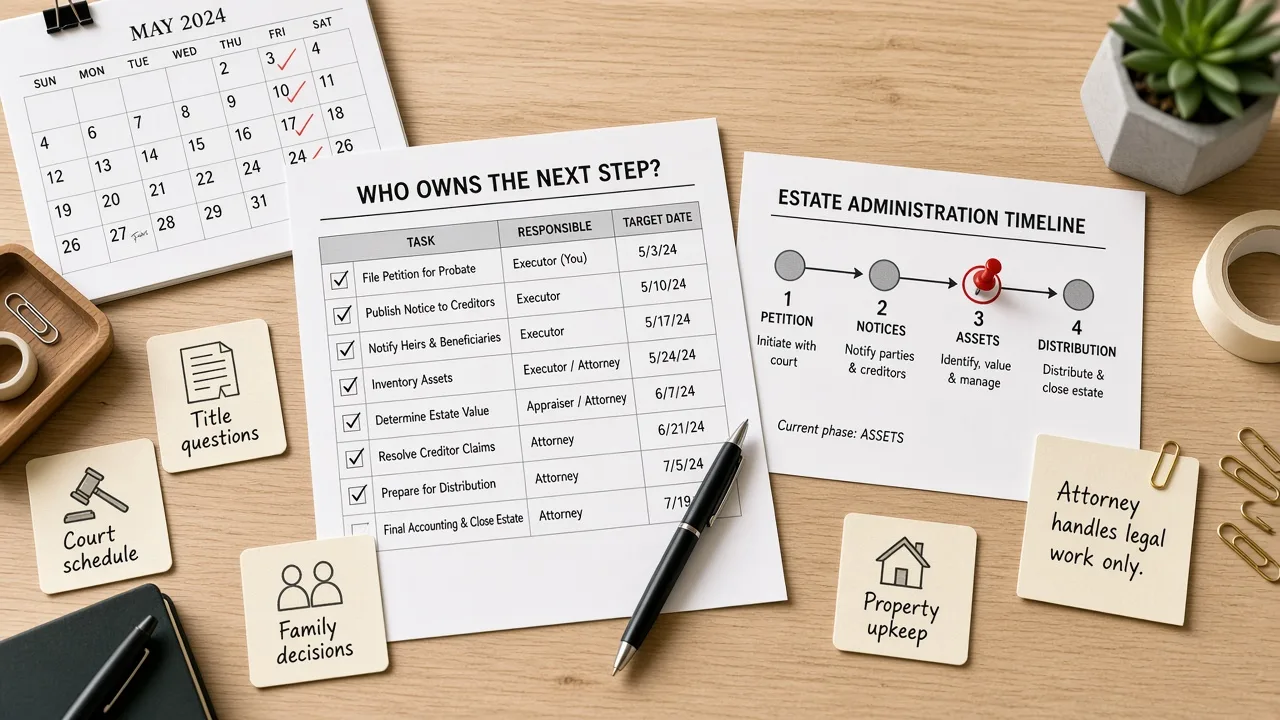
Families who inherit a home usually want one thing more than anything else: a date. When will the house be sold, when will the estate close. I understand that feeling completely. But the estates I have watched run into trouble are rarely the slow ones. They are the ones that treated a promised finish date as a plan, and then discovered that probate moves on its own schedule, with or without that promise.
This is Mistake #4 in our seven-part series based on the free guide, 7 Probate Real Estate Mistakes to Avoid. The fix is not to rush. The fix is to build a realistic, coordinated plan, and let a shared checklist do the work a vague promise never could.
Every estate has moving parts
An inherited home does not sell by itself. Before closing, an estate moves through a string of steps, and each one depends on the one before it: the court steps that give the executor legal authority, the appraisal that sets expectations for price, the cleanout that empties the house, the estate sale that handles the contents, the repairs that make it marketable, the pricing that reflects what buyers will pay, and the closing that transfers the title.
Each step takes real time, and a few depend on people outside the family's control: the court calendar, the appraiser's schedule, the buyers' lender. A quick finish is possible, but only when the steps are sequenced on purpose.
A promised date is not a plan
When someone promises a finish date without a shared plan, they are guessing. They cannot know when the court will issue the letters testamentary , how long the appraisal will take, or what the cleanout will uncover, because none of that work has been scheduled yet. A date that floats free of the actual steps is not a plan. It is a hope with a calendar attached.
The difference matters because families make real decisions on these promises: notice at work, relatives told the closing is set, movers booked. Then the date passes and the estate looks stuck, even when everything is moving exactly as it should.
A shared checklist keeps everyone in sync
The antidote is one checklist everyone can see: the executor, the probate attorney, the appraiser, the estate sale company, and the real estate agent. Each person writes down their next step and when it will happen. The attorney knows when the appraisal is ordered, the estate sale company knows when the cleanout is scheduled, and the agent knows when the house can be priced. Nothing waits on someone else.
This is what coordination looks like. It is not a faster process, it is a steadier one, and steadier is what keeps a family sane in the middle of an estate. When the timeline slips, the checklist shows why and what comes next.
It is the same habit behind the earlier posts in this series: build the right team early, understand how probate works, and compare written proposals before you commit. Mistake #1 got the team in place, Mistake #2 got the facts straight, and Mistake #3 got the work hired on paper.
Guy Courtney is a licensed Texas real estate professional, not an attorney. Nothing on this site is legal advice. For advice about your specific situation, always consult a licensed attorney.