
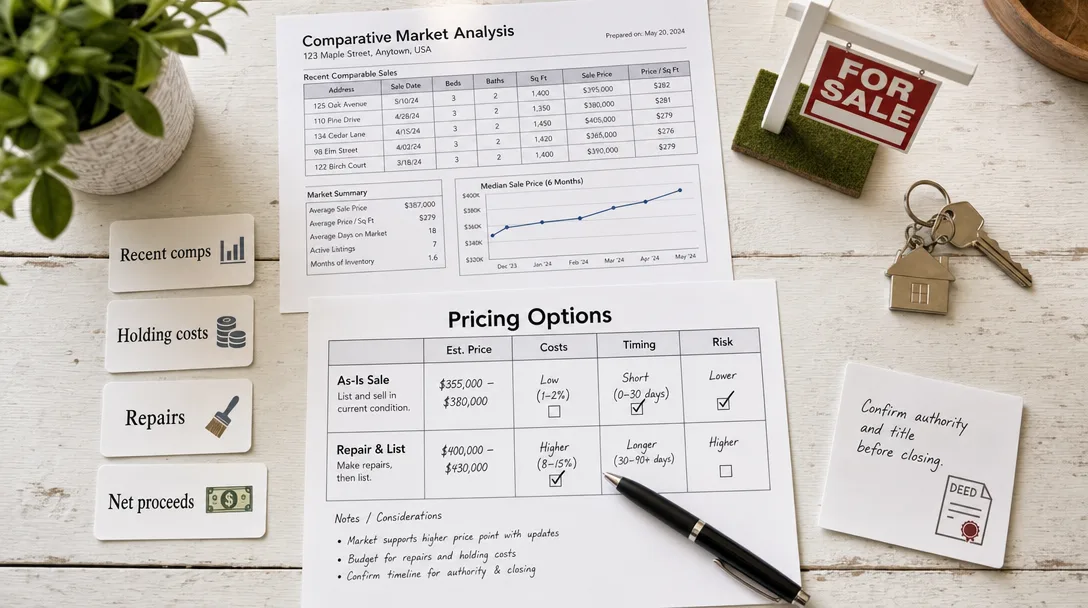
When a loved one passes, the house carries a lot of the estate's weight: its value often decides how much the family eventually receives and how quickly the estate can close. So it matters a great deal that the number attached to that house comes from evidence, not a guess. Pricing an inherited home without market evidence, guessing from sentimental value, what a neighbor is asking, or a number that simply felt right, is Mistake #7 in our seven-part series based on the free guide, 7 Probate Real Estate Mistakes to Avoid.
The guess is never made out of carelessness, and that is exactly why it is so easy to make. The house feels like home, and home is not a market statistic. But the buyers who will decide its price carry none of that history; they compare the listing against the homes around it, today. A starting price out of step with the market costs the estate in two directions at once. Set too high, the home sits, the days on market climb, and later price cuts look worse to buyers than a fair price would have from day one. Set too low, the estate can leave real money on the table.
Why the starting price matters
The list price does more than quote a number; it sets the expectations of every buyer, and every buyer's agent, who opens the listing. A home priced well above the market reads as overpriced, so buyers pass it by. The longer it sits, the more a price cut looks like bad news, and each reduction makes the next offer smaller and slower to arrive. On the other side, an underpriced home can look like a bargain and sell quickly, but the estate is left wondering what an informed buyer would really have paid. Either way, a guess, not the market, sets the price.
What a guess actually looks like
- Anchoring on what a neighbor is asking to list, without checking what comparable homes in the area actually sold for.
- Pricing from sentiment: what the home meant to the family, what it cost years ago, or what it ought to be worth.
- Ignoring current market conditions, whether the neighborhood is heating up, cooling, or holding steady right now.
- Skipping professional advice and putting a number on the sign without a current comparative market analysis.
The market evidence behind a defensible price
A defensible price rests on evidence. Recent comparable sales are the foundation: homes genuinely like this one, in the same area, sold recently for what buyers actually paid. The home's condition matters just as much, what a buyer can see from the street, whether it shows well, and what needs attention before it can sit beside move-in-ready neighbors. A comparative market analysis (CMA) pulls all of it together, comparing sold, pending, and active listings so the price reflects what the market is doing today, not what the house meant to the family.
Sentimental value is real, and it is not a price
Every room in an inherited home holds memories, and none of that is wrong. The mistake is letting the feeling answer a financial question. A buyer is not buying the family's history; they are buying a house in today's market. A probate specialist understands both halves of that: the weight of the decision, and the need for a price the evidence supports.
The role of professional advice
A market analysis is not the only figure an estate may need. A date-of-death valuation can be required for tax or estate purposes, and that is a different calculation from today's listing-price analysis. Your tax advisor or attorney can say whether an independent appraisal is needed. The point is the same as the rest of the series: build the decision with evidence and the right professionals around you, so the price is defensible to the family, to buyers, and to the estate.
Mistake #7 closes the series, and it is the mistake that turns the rest of the work into numbers that protect the estate. The free guide, 7 Probate Real Estate Mistakes to Avoid, walks through all seven so the price is only ever set on evidence, with professional advice behind it, and never on a guess.
Guy Courtney Steib is a licensed Texas real estate professional, not an attorney. This article is educational, not legal advice. Market data and property values change over time, so confirm current comparable sales, professional guidance, and any required valuation with a licensed real estate professional, a tax advisor, and your attorney.